The best things in life are free, as are many of PIANC’s publications!
Several important climate change and decarbonisation reports and technical notes are available for FREE from PIANC International. See our list below.
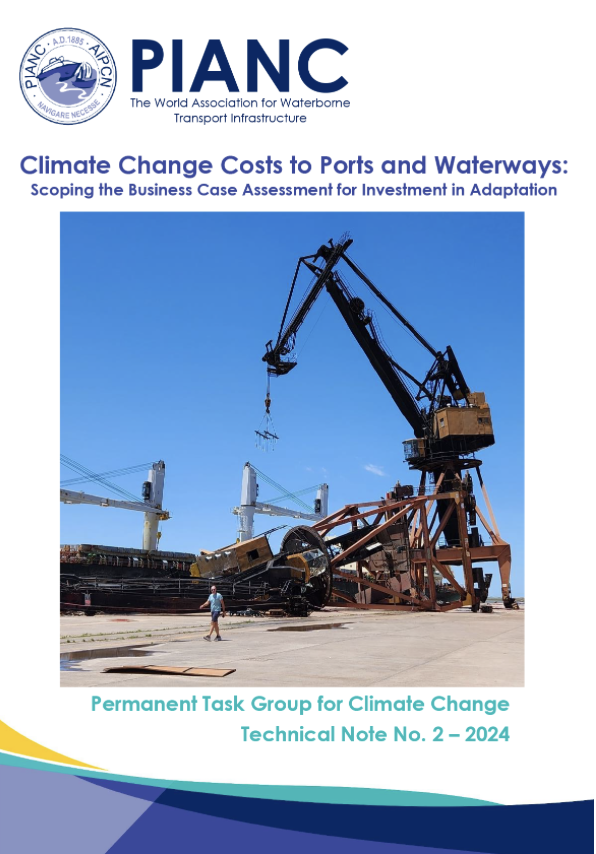
PTGCC 2: Climate Change Costs to Ports and Waterways: Scoping the Business Case Assessment for Investment in Adaptation (July 2024)
Produced by PIANC’s Permanent Task Group for Climate Change (PTGCC), this Technical Note explains how potential costs and benefits can be identified and quantified to support the case for investment in adaptation action. It discusses the concept of climate change inaction; the ‘triple dividend’ benefits that can be realised by adapting and strengthening resilience; and the role of the losses-avoided principle in supporting the business case.
It also highlights the potential relevance to some ports and waterways of the evolving position of the finance and insurance sectors; growing expectations in relation to climate-related financial risk disclosure; and the possible implications of failing to meet regulatory requirements or contractual obligations.
Download here: https://pianc.org.au/wp-content/uploads/2026/01/EnviCom-PTGCC-Technical-Note-2-FREE-2024-Climate-Change-Business-Case-FREE-Publication-.pdf
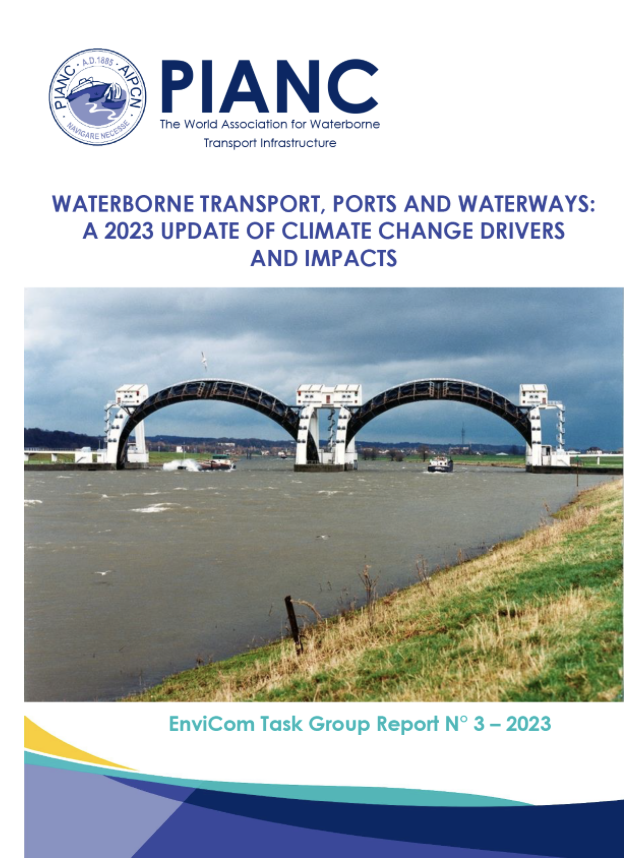
PTGCC TG3: Waterborne Transport, Ports and Waterways: A 2023 Update of Climate Change Drivers and Impacts. (October 2023)
This report, prepared by members of PIANC’s Permanent Task Group on Climate Change, updates PIANC TG 3 (2008) with the improved climate change knowledge as of late 2022. The update presents an overview of the key messages regarding, the projected climate change impacts on maritime and inland navigation including from changes in air and water temperature, sea level rise, wind conditions, wave action, tidal and surge propagation and range, ocean circulation, storms, coastal hydrodynamics, ice conditions, icing, water supply and quality in inland rivers, extreme hydrological conditions, and coastal, estuarine and river morphology.
Relevant chemical and biological changes and their potential implications for navigation are also discussed. The need for adaptation responses and measures to strengthen resilience is highlighted. Navigation contributions to greenhouse gas (GHG) emissions are also briefly reviewed, along with opportunities for navigation to contribute to overall reductions in anthropogenic GHG emissions.
https://pianc.org.au/wp-content/uploads/2026/01/EnviCom-TG-3-WT-Ports-Waterways-2023-.pdf
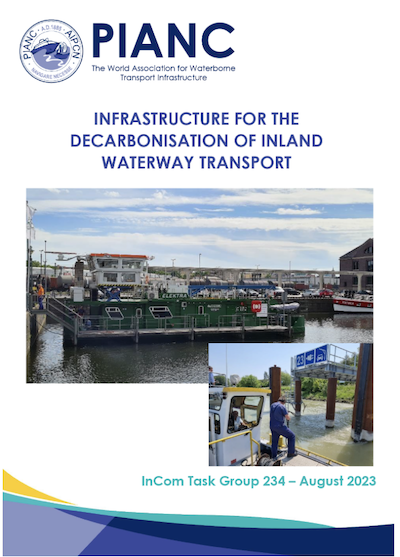
InCom TG234: Infrastructure for the Decarbonisation of Inland Waterway Transport. August 2023
TG 234 compiled a course overview of key decarbonization developments at different scales (per continent, corridor, country and organisation that participated in the TG). Similarly, main developments for a number of promising energy carriers were compiled. To provide concrete handles for actors that face the challenge of developing (policies for) infrastructure for the decarbonization of IWT, a set of key questions is proposed. Additionally, a method is proposed that actors could apply to generate answers for these questions.
TG 234 recommends that PIANC should consider setting up a WG that focuses not on infrastructure hardware, such as dimensions and standards of bunkering stations, but rather on pathways and decision making for decarbonisation of IWT. A pathway is understood as a way to organise the transition from a fleet (existing and newbuilds) into a decarbonised fleet over a few decades.
Download Here: https://pianc.org.au/wp-content/uploads/2026/01/PIANC-InCom-TG-234-Decarbonisation-FREE-2023.pdf
PTGCC 1: Managing Climate Change Uncertainties in Selecting, Designing and Evaluating Options for Resilient Navigation Infrastructure (April 2022)
PTG CC Technical Note 1 aims to help project owners, designers and financiers deal with climate change uncertainties – not only in relation to the selection, design and evaluation of options for new waterborne transport infrastructure, but also the maintenance or modification of existing assets.
The Technical Note offers an insight into the critical role of adaptive and flexible solutions including ‘no-regret’ options, and it highlights why non-structural (e.g., operational, institutional) as well as structural interventions should be assessed. It focuses on the use of monitoring to inform decision-making (adaptive management). Finally, it stresses the importance of selecting option evaluation methods that recognise and accommodate uncertainty.
Download here: https://pianc.org.au/wp-content/uploads/2026/01/EnviCom-PTGCC-Technical-Note-1-2022-Managing-CC-Uncertainties-FREE-Publication.pdf
OTHER FREE PIANC PUBLICATIONS
TG181 The State and Perspectives of Waterborne Transport Infrastructure Worldwide (2018)
Download here: https://pianc.org.au/wp-content/uploads/2026/01/PIANC-Task-Group-181-2018-_Free-publication.pdf
RecCom: WG177 10 Years of the Marina Excellence Design ‘Jack Nichol’ Award (MEDA) (2017)
Download here: https://pianc.org.au/wp-content/uploads/2026/01/PIANC-Free-Publication-RecCom-WG-177-Ten-Years-Jack-Nichol-Awad-_-2017.pdf
REMEMBER! You can also subscribe to the FREE newsletter from PIANC International! Go to https://www.pianc.org/subcribe-newsletter
or subscribe to our local AU-NZ FREE newsletter.